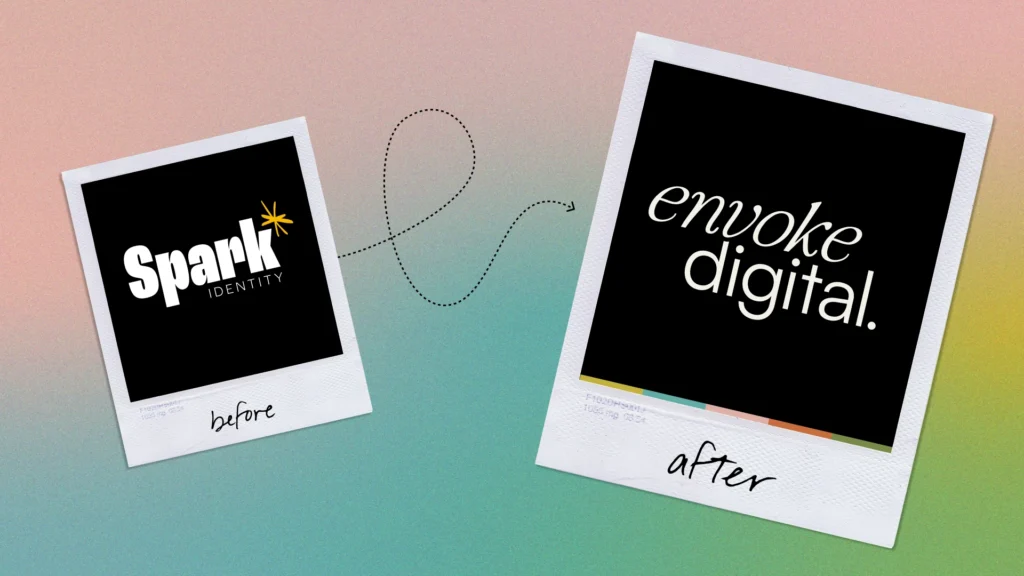

A rebrand can start with a feeling that your brand no longer fits the business behind it. We know, because we have lived it. That unsettled feeling grew until our old brand, still carrying the name of our freelance days despite the growing team and widening Australian client base, became Envoke Digital. This is what that rebranding journey looked like from the inside, mistakes included.
Why we decided to rebrand
Our brand hadn’t kept up with our business. The team and the work we were producing had grown well past what our logo, website, and messaging said about us, and the gap kept getting harder to ignore.
Think of a mechanic who still drives a beat-up old car, or a builder who lives in a half-finished house. That disconnect is uncomfortable to watch, and it was uncomfortable to sit in ourselves. Nothing about it was sudden, just a growing unease that something no longer fit. If you’re already asking yourself whether you need to rebrand, that could be a sign that you do.
What our rebranding process looked like
The initial rebranding process took a few months from go to launch, with phase two currently underway with the creation of ongoing SEO/AEO pages and blog content to round out the site.
With the seeds of the new brand planted much earlier in our minds, the visual basics, logo, fonts, colour palette, came together fast. The slower part was everything underneath: rebuilding the website and developing a proper tone of voice to match the new positioning. The visuals were the easy part by comparison.
As a strategic web design and branding studio, we had all the skills required to complete the entire rebrand in-house including the strategy, design, copywriting, and development of the project. Team buy-in brought different experience and opinions to the table to create what you see today.
Of all the pieces, name and logo came first, because the name carries the most downstream consequences with domain availability, and whether your social handles are even free to claim.
Our biggest rebranding mistake
Our biggest mistake was skipping our own strategy session as a starting point.
As designers rebranding ourselves, we skipped the groundwork we’d never let a client skip: a properly fleshed-out positioning document, a North Star to measure decisions against. Without it, some choices got made on instinct rather than evidence. We caught this later and ran a full team workshop to fix it, which is now feeding into Phase 2.
Some of the hard parts
Skipping the initial strategy session wasn’t the only hard part.
Rebranding involves far more tasks than anyone expects, and finishing means checking off every one of them, even the unglamorous ones. There are just so many things to do that you lose stamina, but it’s important to check off on all points.
We also underestimated the emotional weight of it. Pitching a new, more premium position means living up to it, and that brings a real strain of imposter syndrome. Can we deliver on the brand we’re now presenting?
Local SEO created its own tension with our old brand leaning hard on ‘Bundaberg’, while our new positioning was aimed at clients Australia-wide. We had to re-evaluate that almost immediately, because what served us locally didn’t serve the business we were becoming.
Our rebranding strategy, step by step
Here’s roughly how our own rebrand played out, step by step.
- Name and legal groundwork, locked in first
- Visual identity, logo and colour palette
- Tone of voice to shape the personality of our brand
- Keyword research and copy, written to the Figma mockups
- Website rebuild, built around everything before it
- Technical SEO migration, via Google Search Console
- Gradual rollout, still ongoing in Phase 2
Treat your rebranding strategy as a sequence with dependencies, not a checklist to tick off in any order. Getting the name and legal side locked in before you invest in visuals saves you from redoing work later.
How to rebrand without losing your existing customers
We didn’t lose customers in the rebrand, and our website traffic held up too.
Far from causing confusion, the new brand positioned us better for the interstate and larger clients we wanted, because we now presented as a premium, sophisticated studio rather than a local freelance practice.
The web traffic side took deliberate work. A full name and domain change can really reduce your search visibility if you’re not careful. We protected our existing traffic and views by using Google Search Console to redirect and rename pages rather than starting fresh, and our organic traffic is now slowly creeping up further.
If you’re weighing up how to rebrand without losing customers, we suggest you take on the same approach.
What changed after the rebrand
Day to day, not much actually changed. We were already doing the work and already positioned close to where we wanted to be. The rebrand just gave us permission to present that way properly, as a studio rather than a freelance practice.
The feedback since launch has been overwhelmingly positive. People have described the new brand as more mature, more considered, like we really look like we have our act together. That response matters more than any metric, because it confirms the personality of who we have become.
Was it worth it? Definitely. It’s hard to run a business you feel embarrassed to show off. Once that feeling is gone, you feel proud to share your work again.
What we’d do differently next time
If we started again tomorrow, the plan would stay the same, but the implementation would look a bit different.
While we had a solid launch plan, we simply didn’t follow it closely enough, so tasks slipped later than they needed to. Time-blocking specific work on the rebrand, rather than squeezing it between client deadlines, would have kept momentum up.
We’d also run the strategy workshop earlier, like we do for all of our clients. A clear North Star from day one would have saved some of the iteration that occurred later in the project.
We already know how to do this well, whether it’s a new brand or a rebrand. That’s the work we do for clients every day.
Going through our own simply reminded us why we take that process so seriously for everyone else.